How to get a horse working from behind more?

juliecwuk

Well-Known Member
Mar 2, 2006
7,888
761
113
42
Wolverhampton
Just wondered how you get a horse working from behind more? i have seen it mentioned quite a few times, but since i am very basic in my schooling i didnt really know how you actually do it!! sorry if its a dumb question!!
 
I use the image of a concertina - you need to hold one end fixed, and squash the other end up to it - the energy is kept in between the two.

When I used to ride at the RS, I found the easiest way to do this is to really have a good "run" around the school - you need the energy before you can collect it, cantering long down the sides - loose contact lots of leg is the easiest gait I find to get the most momentum as tend to go up a speed in walk and trot rather than have "impulsion" in that gait, then using hands and seat start to collect the front end up, so you still keep the impulsion and energy you have but you want to "contain" it and stop it escaping out the front, that then encourages the horse to bring its back end more underneath and work up and into your hand to lighten the forehand... sorry if thats a bit jumbled!!
 
the best way is to find an instructor who has a horse who
works through from behind" -- so you can watch that horse to get a good picture -- and ride that horse so you can feel what it is like....

that is the easiest way to learn it and once youknow what it is like and how to achieve it on a trained horse, you can start thinking about helping your horse find the same feel

best

Cathy
 
You do need either eyes on the ground, or lessons on an experienced horse first. Some useful exercises however are transitions between and within the paces, lateral work (especially pushing the haunches out for a few strides, shoulder in etc), always looking for obedience to the aids. The horse shouldn't wait ages to respond to your requests to go forward, his response should be immediate.

I would be very careful of applying hand and leg at the same time. As Philippe Karl quite rightly says, in applying both at the same time, you immediately make the horse disobedient to one or the other aids. The horse cannot stop and go at the same time! In creating more activity from the haunches, you need to first look at training a quick and accurate response to the leg aids, and then look at getting the horse more supple and evenly muscled, by introducing careful and considered lateral work and suppling exercises.
 
PFB gave a great answer!

It shoul feel like every stride is the horse pushing you along with its back legs and like there's loads of power carrying you forward. This is in contrast to a lot of horses where you almost feel like you're having to drag or compel them forward yourself. As PFB says its really important to get the energy first - you should spend as much time as you need at the start of a schooling session getting your horse really forward in all paces without you having to nag. You might have to be a bit aggressive about it to start with and back up with stick if necessarry but you will eventually find that your horse will go forward in an active trot forever until you tell them otherwise! Only then can you start 'picking up' the front end and you have to do it gradually so that you aren't giving confilcting aids by taking too strong a contact before your horse understands that you don't mean them to slow down.
 
Sorry lack of clarity there... I didnt mean to apply a rein aid (ie. not as if you were stopping) as I agree it send mixed sigals, however the front end needs to be "held" and the contact offered for the horse to work "into a contact".

On well schooled horses, the impuslion need not be contained as such, but on greener horses, when asked for more energy, the tendency is a run response, rather than a "bounce" or energy response. You want up and down energy or bounce, rather than forward travel - greener horses will produce a flatter, but fast pace wheras generally a more schooled horse will understand and provide extension/collection, but for unbalanced/green individuals, it is easier to switch up a gear. To prevent the run response, there needs to be a ccontact available, which isnt asking to slow, but is asking to not rush any further forwards.
 
Excellent answers from everyone, but from your post it wasn't clear (to me!) whether you understood the idea behind 'working from behind', so I thought I'd offer a basic definition. Sorry if I'm stating the obvious!

'Working from behind' means that the horse engages his hind quarters to generate power and forward movement. The alternative is to be 'on the forehand' where a horse kind of drags himsef along by his front legs.

If a horse is working from behind, his back will tend to round up and his head drop. When a horse is on the forehand he will have a hollow back and a raised head. If you get on all fours (honest!) you can see that if you hollow your back and raise your head then crawl forward, the weight is on your front arms. If you round your back and tuck your chin in, then your weight is further back and it is easier to move forward.

So working through from behind is an efficient way for a horse to carry himself and the weight of the rider.

As to how you achieve it, have lessons! But beware! Some RIs are obsessed with head position and will focus more on that than on free and forward movement. If a horse's head is pulled into the 'right' position but the horse is hollow and on the forehand, then he will not be using himself correctly, no matter how impressively 'on the bit' he looks.
 
I think you described this very well, I like the consatina idea :)
I use the image of a concertina - you need to hold one end fixed, and squash the other end up to it - the energy is kept in between the two.

When I used to ride at the RS, I found the easiest way to do this is to really have a good "run" around the school - you need the energy before you can collect it, cantering long down the sides - loose contact lots of leg is the easiest gait I find to get the most momentum as tend to go up a speed in walk and trot rather than have "impulsion" in that gait, then using hands and seat start to collect the front end up, so you still keep the impulsion and energy you have but you want to "contain" it and stop it escaping out the front, that then encourages the horse to bring its back end more underneath and work up and into your hand to lighten the forehand... sorry if thats a bit jumbled!!
 
I wholeheartedly disagree about the front end needing to be "held". IMHO, there is too much of a hurry to have a horse working in a "frame", which encourages a lot of riders to get handy as a result. Development and strengthening of muscle takes many months, not weeks, so it is only fair that we as riders are patient and wait for our horses to develop the necessary strength and power to carry us without the loss of balance that you refer to. Once the horse is strong and supple, if he has been worked correctly, he will offer a soft contact into the rein and maintain his frame in all paces.

Contact is a gift from the horse to the rider, when he is strong and trusts the hand at the end of the rein. It is not something that the rider has the right to "demand" from the horse. We can certainly encourage it through our careful work programme, but we should not be rude about taking it.

The flattening that you refer to from young or unschooled horses is certainly true, but should be solved by work to improve their balance and suppleness. The rushing primarily comes from being pushed for longer paces or for "tracking up" before the horse has sufficient balance and strength to maintain self carriage in that sort of work, hence they fall on their nose and rush off. The solution is many patient repetitions, pushing the horse's comfort zone GRADUALLY, gently demanding a little more each time, and using primarily the seat and back to slow the horse without yanking the reins. And bearing in mind the fact that muscle bulk and strength takes months to build up.

I appreciate that I may be singing from a different hymn sheet than many of you here, but I have been very lucky to train with some ex-Cadre Noir instructors in the techniques of French classical dressage. Most of you will know that the Cadre Noir produce excellent horses, who work at high school level and compete at International and Olympic level, so these techniques really do work. The methods attract me because they are completely FOR the horse, they work with the horse's nature and natural development and never, ever, put the rider's ego or ambitions first. I have tried the methods of riding the horse into a contact and for me it felt rough and primitive, it did not sit comfortably with me at all. I have strong ethics about what we demand from our horses, and a very strong interest in biomechanics of the horse, so several years ago I turned to the classical methods instead.
 
Funny, I dont see you as singing from a different hymn sheet at all. I agree with you, although I mentioned no time frames - and if you saw me ride - you would see I dont even dream of asking mine for a n outline - she is grossly under developed muscle wise and overweight. We are working on her relaxing to accept the bit - I took her on as a headstrong, nappy pony and to get rid of this I need her to soften at the poll and through her neck and jaw to actually get her to listen - let alone track up/bend correctly/work in an "outline"... I think previous posts show how much I detest "working in an outline" or "on the bit" its one of my biggest bug bears - I was forever criticised about not working Sil "on the bit" as she "does it so nicely and easily" - when actually she was using it to evade and was hollow through her neck. We've spent 12months riding (on and off), changing tack, having teeth and back done and now finally I can get her to work with her neck long and low, it looks awful, but at least she isnt tense. Now she understands I want her to work like that (not "pulled in") she is happy too, so we have progressed now to working on listening to the bit and accepting it/playing with it and softening at the poll - Im only getting a few seconds of really nice work from her, but its getting more each time - it will take us most of the summer if not longer to have this at a level where I am happy to progress to even contemplating increasing the pressure.

...And don't even get me started on my "on the bit" rant :p :D

Oh and some photos.... because I like photos!!!!!!!!!!!!!!

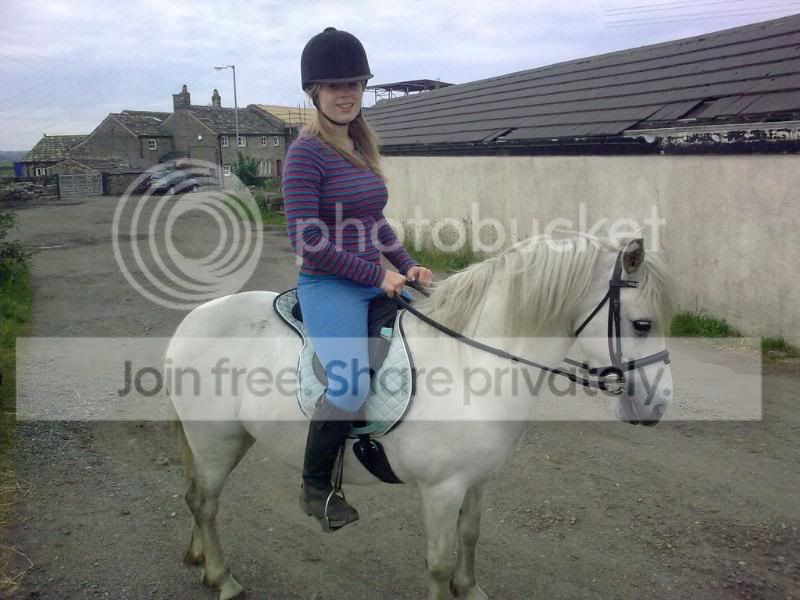
Silver "on the bit" last summer when I took her on
e12062009130.jpg


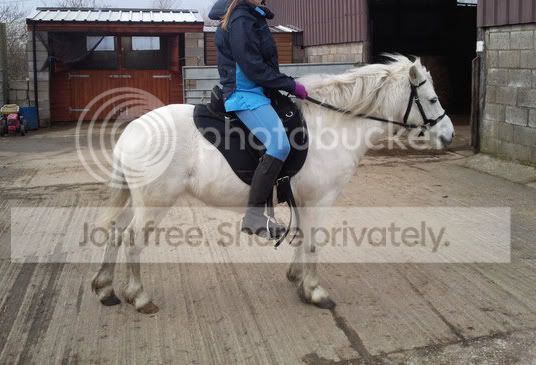
Christmas - sporting the "stretched out" look - its a compromise - it looks atrocious, but was necessary to encourage her to stretch through her back and neck
edit.jpg
 
Last edited:
That's great to hear, good for you! Sorry, your previous posts on this thread were a bit misleading and I obviously got the wrong end of the stick.

I too have had tonnes of criticism for not rushing my young horse - yes, seriously! I backed him at rising five, no earlier as a) he is a late-maturing breed and b) he had been underfed so needed to put a lot of condition on and c) he knew diddly squat when I bought him as a 4yo so had lots to learn about leading, lunging, long reining, in hand work etc, there was no rush to put a rider on board.

Last year he had 7 months off schooling due to a ligament injury, so is quite green for a six year old my most people's standards. The comments I have had range from "I'd back him now, whilst he's too weak to object!" to "It doesn't matter that he was started late or had time off due to injury, he is six now, people will expect more of him!!" and this week my instructor (or now ex-instructor) said he should work more into the contact and have sharper transitions - this when he was clearly having an off day, was quite tense and struggling to concentrate!

S0d them all, do things at your own pace and listen to the horse. Today I had a lovely ride, my horse was relaxed and working nicely into my hand (funny that he will do that when he's in the right frame of mind - oh right! He's a horse, not a machine...), did lovely shoulder in, travers, renvers, and even happily tried his first ever walk half passes on each rein, going right across the diagonal each way, happily and calmly. I used to think half passes were quite tricky, until my Cadre Noir trainer said they are just travers on the diagonal - oh yeah! Duh...

I hate the obsession with "roundness" and nagging legs and rushing horses that we are seeing more of these days. It's just not necessary!
 
Bloody hell. We're lucky if we walk in a straight line.... :D

We can do nice 180 turns on the spot to the right... cant even look left... LOL

This is another exaple of what I mean - this horse does no schooling, this was our first attempt - and I was criticsed for "not working her on the bit" - to me this is what I would expect from a green neddy - she is reaching down, and stretching through her back and working nicely - things to be improved yes, but a nice way to begin - she is naturally a tense and anxious horse (being part arab and all :p) so these moments were sporadic, but gradually increased with practice and consistancy.
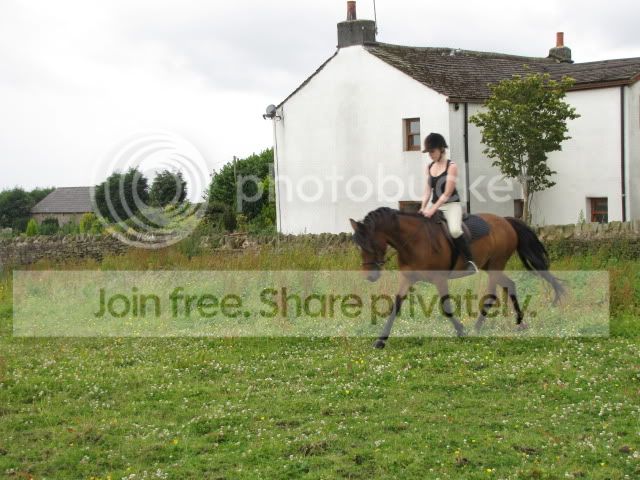
EllieMaeII024.jpg


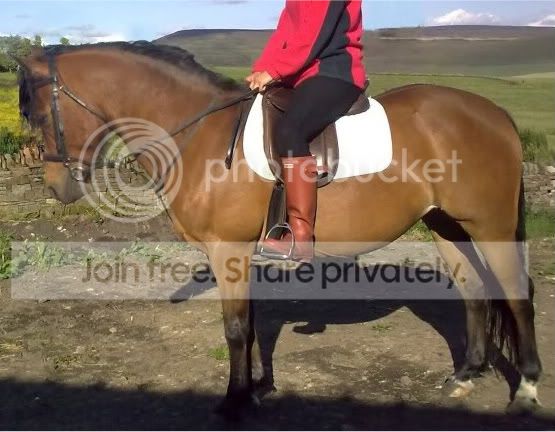
This was how she should have been ridden apparently... "on the bit" - to me its hollow and behind the bit... but who am I?? :D:p

e11062009123-1-1.jpg
]
 
Last edited:
Much nicer first picture there! Mine has a similar problem to your grey - nothing to do with previous training, just his build, he has a very high set neck and likes to tuck behind the contact, like this:

P1000864.jpg


We had words and explained that rollkurring oneself in a French classical dressage clinic is really not the done thing.... :)

We do nothing to influence the head position, but plenty to activate the hind legs and get the horse supple. When the rest of the body is ready, the head will sort itself out. More pics where you can see the work to engage and supple (hopefully!)

My leg is back here because I am pushing his haunches out a bit.
P1000826.jpg


P1000754.jpg


Leg yield out of a circle preparing to canter
P1000774.jpg


I have only very recently been able to encourage him to stretch down and work forward, downward, outward with his nose. This is a key part of any horse's training, but previously he would resist the request because he was not strong or balanced enough to maintain his frame. Forcing the issue would have been completely counter-productive. Now we can work on getting more relaxation over his back and more swing in the steps by working him lower now and again.

Sorry to hijack thread, but it's still kind of on topic - isn't it.....?!
 
Interesting, Ive gone completly the other way with the training to you though!

I decided (not sure when, but at some point must have!!) that it was more important to us to stretch and relax than work on lateral work/tracking up etc - because, primarily, she sets her neck, opens her mouth and disappears wherever she wants. I also wanted her schooling out of the above neck position as she was evading. Now she is happy to work with her nose on the floor (no out line, just nice to have some neck in front of me!!!), we are working on our napping/bending issues as these are next most important - but I couldnt be doing this now if her head was still set - she now knows there is a choice, she can work longer and more relaxed and have an "easy" time... or do what she pleases, with a set neck and make more work for herself.
 
PF I am delighted you replied with your explanation and pics of silver when you first got her and now. Such a relief to see EXACTLY what I have been working through with JJ since I got him last July.

Like Silver, when I got him he did a very impressive looking trot, always at a flat out driving horse pace with his nose permanently tucked into his chest no matter how light my contact was. To slow down the trot and getting him working in a more relaxed manner and without a rigidly curved neck I have also been riding him as you have in the 2nd picture. Some people commented that he looked much better and more 'posy':rolleyes: working with the nose tucked in.:mad:

Maybe he did - but I am not in the business of looking posy and just want a relaxed horse working nicely and with the correct carriage through out his neck and head.:) We have now just started to progress from the long, low and relaxed and I am tring to now get the more 'rounded' picture from him - only taken since last July and many changes of bit and tack to get this far - but hey - he is far more happy and relaxed and we have all the time in the world.:D
 
PF I am delighted you replied with your explanation and pics of silver when you first got her and now. Such a relief to see EXACTLY what I have been working through with JJ since I got him last July.

Like Silver, when I got him he did a very impressive looking trot, always at a flat out driving horse pace with his nose permanently tucked into his chest no matter how light my contact was. To slow down the trot and getting him working in a more relaxed manner and without a rigidly curved neck I have also been riding him as you have in the 2nd picture. Some people commented that he looked much better and more 'posy':rolleyes: working with the nose tucked in.:mad:

Maybe he did - but I am not in the business of looking posy and just want a relaxed horse working nicely and with the correct carriage through out his neck and head.:) We have now just started to progress from the long, low and relaxed and I am tring to now get the more 'rounded' picture from him - only taken since last July and many changes of bit and tack to get this far - but hey - he is far more happy and relaxed and we have all the time in the world.:D

PMSL :D:D - All I want is a horse that goes where I ask, with a reasonable level of obedience. :D:D:D (Opposed to last summer who used to gallop home with me, hell for leather :p) We have the "goes where I want" sorted, just the obedience issue to go.... LOL. She is opinionated anyway, I like that, but I dont like it when its rude or not for a good reason ie. she thinks its not clever to jump a 10ft hedge... fair do's, but just because I ask her to walk on does not mean she needs to do on the spot circles and fight with me!!!
 
You often have to take a different approach with a remedial horse than one with no issues.

As I said, demanding a longer, lower neck from my horse any earlier would have ruined his balance and dropped him right onto the forehand - quite an achievement as he has very good natural balance! Trawling along on the forehand does no horse any good towards their physical development - but I agree, sometimes it is necessary for a short time if it helps towards relaxation and keeping control!!

Working in balance in a longer frame is actually quite hard for a horse to do well, they need a certain amount of strength in their core muscles to hold themselves up.

So whilst long & low work is important for all horses, the stage at which it is introduced can vary according to the individual and their requirements - there is never one set training pattern for every horse, they don't read the books, lol! The most important thing is that when the horse is asked to stretch out and down, he is relaxed about it and can continue to work in balance and with engaged hindquarters.

Just to pick up on something you said - I never work on tracking up. I personally don't think it is a reliable indicator of a horse working well. Lots of horses are not physically capable of doing this well without losing their balance, rushing, and recruiting the wrong postural muscles to hold themselves up, or even worse, recruiting locomotor muscles into the role of a postural muscle! I just look for flexion in the joints of the whole haunches, as far as that individual horse is able.

And finally, a note from Dr Gerd Heuschmann, guru of all related to equine biomechanics. Re the FDO work (forward, downward, outward), he does not recommend that the poll goes below the line of the top of the wither for most horses. Any lower, and the horse will unavoidably go on his forehand. Nose outward and poll no lower than the wither will put just the right amount of pull on the nuchal ligament on top of the neck in order to recruit the supraspinous ligament in the back to do it's role as a supporting ligament, allowing the long back muscles (longissimus dorsi) to function as nature intended, as locomotor muscles. Any lower and with the horse on the forehand, or worse, the horse cranked into a hyperflexed posture in the neck, and the longissimus dorsi cramps up to help support the horse, loses it's natural function, and the whole thing has a knock on effect around the rest of the body, making the horse more prone to back (esp sacroiliac) and limb problems. :)

Hence my reluctance to ask for the downward stretch until my horse was happy to offer it without protesting!
 
newrider.com